
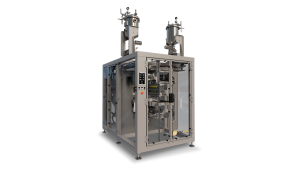
Sachet filling is a vertical form fill seal (VFFS) process. Two faces of film are drawn from a single reel, brought together and sealed down both edges to form an open-topped pocket. Product is dosed into that pocket, the top is sealed, and a cutting station separates the finished sachet from the web.
Sealing on all four sides is what gives the sachet its barrier performance. The seal path is continuous, and pressure and dwell time can be tuned independently on the vertical and horizontal stations. That matters most with technical films of three and four layers, where seal quality decides whether the pack holds its stated shelf life.
Control is through an industrial PC and touch screen, with servo-driven motion on the film transport and sealing stations. Recipes are stored per product, so a changeover recalls known-good settings rather than depending on how the machine was set up last time.
Three frames cover entry-level production through to high-output lines. All models run on 220, 400 or 440 V AC three-phase at 50 or 60 Hz and require compressed air at 6 bar.
Every frame is cabinet-enclosed with the film path protected, and the powder dosing units are mounted on a mobile platform that rolls out for cleaning rather than being stripped in place.
MVA12 for Hand Sanitiser
MVA12 for Food Industry
MVA4 EVO Sachet
Each lane needs its own share of the reel. On the MVA12, four lanes gives a 150mm sachet at 280 a minute; fifteen lanes gives 40mm at 1050 a minute.
The ILPRA UK team will help you configure the dose, the sachet dimensions and the print area your pack needs, then identify the frame that reaches your volume at that width. Where the numbers sit near the top of one model’s range, the larger frame with lanes left spare is usually a better long-term choice.
Pack format sits alongside that decision rather than after it, since stick and sachet formats reach their output differently for the same dose. Take a look at our guide to choosing between stick packs and sachets for more detail.
The same frame handles very different products depending on how it is dosed. Liquids and semi-liquids are filled volumetrically or by piston, with flowmeter control where accuracy has to hold across a long run. Powders run on auger dosers sized to the product’s density and flow characteristics. Granulates and solid pieces run on cup or counting systems.
Alongside a standard straight-cut rectangle, sachets can be produced with laser scoring, rounded corners, a diamond profile and a top-seal finish. Double sachets join two packs with an intermediate perforation and triplex formats extend that to three. Shaped sachets are available, too.
Coding is built into the machine, with laser, inkjet and thermal transfer overprinting available, so batch, date and traceability marking runs at line speed.
A machine producing 800 sachets a minute goes through reel stock at a rate that outweighs the capital cost of the equipment within a few years, and film that has not been matched to the machine can result in seal failures, web wander and scrap long before it shows up as a saving.
We supply sachet film roll as part of the same conversation as the machine, in structures chosen for your product’s barrier and shelf-life needs, and it is available from commissioning rather than sourced separately once the equipment lands. Where the application allows it, recyclable and recycled-content structures can be specified without giving up seal performance.
A sachet machine is only as consistent as what feeds it, so most installations pair the machine with a dedicated product loading system sized to the doser.
Transfer systems move sachets off the outfeed, in-line weighing and camera inspection handle quality control, and end of line packaging equipment collates sachets into retail cartons. The machines are designed to integrate with secondary equipment, so cartoning and automation can be added later without rebuilding the line around them.
Installation and commissioning are carried out by our engineers, with operator training delivered on site as part of the handover. Servicing and maintenance, planned callouts and spare parts are all handled in the UK, which keeps response times measured in hours rather than days.
MVA4 EVO
1 - 4
400mm
40 - 200mm
50 - 200mm
280 sachets/min
550 kg
MVA9
3 - 12
1000mm
40 - 150mm
50 - 200mm
840 sachets/min
2,100 kg
MVA12
4 - 15
1240mm
40 - 150mm
50 - 200mm
1050 sachets/min
3,000 kg
Model: MVA4 EVO
Model: MVA9
Model: MVA12
FAQs
Sachet Machine FAQs
Between 70 and 1,050 sachets a minute depending on the model and the number of lanes fitted. Those are machine speeds at optimum conditions. The rate you sustain in production depends on the dose, the product and the film, which is why we trial before quoting.
Not simultaneously, the dosing head needs to be changed. The frame is common but liquid dosing and powder dosing are different units. If you need both, the machine can be built to accept interchangeable dosing systems.
Sachets run from 40mm to 200mm wide and 50mm to 200mm long. The maximum width available on a given machine depends on how many lanes are fitted, since all the lanes share the same reel width.
Recipe-level changes such as fill weight, sealing temperature and sachet length are made on the touch screen in minutes. Changing sachet width means changing tooling, which is a longer job. Machines specified to run a defined set of formats can be built with changeover in mind, which makes a substantial difference in practice.
Where a line runs several formats a week, changeover is worth planning as part of your overall uptime rather than treating it as a fixed cost, which we cover in our guide to changeover and downtime planning.
Yes. Versions adapted to pharmaceutical regulations and documentation requirements are available, and the enclosed cabinet design protects the film path from the production environment. The specification is built around the standards you need to satisfy.
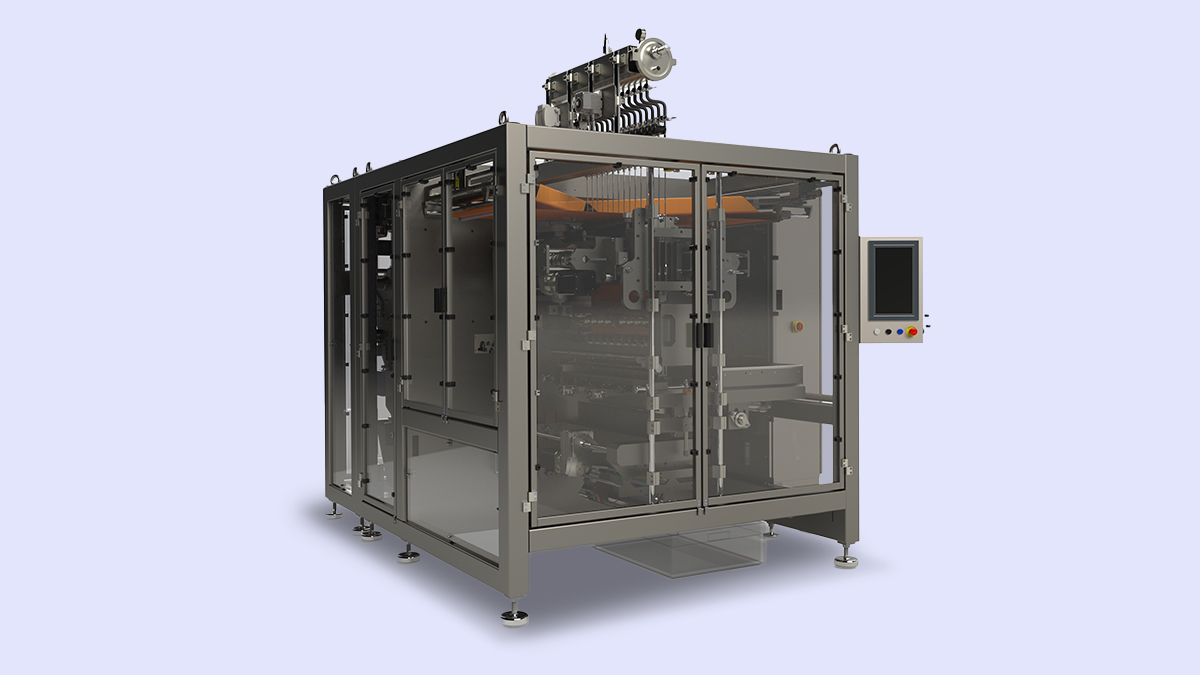
Model no: MVA12
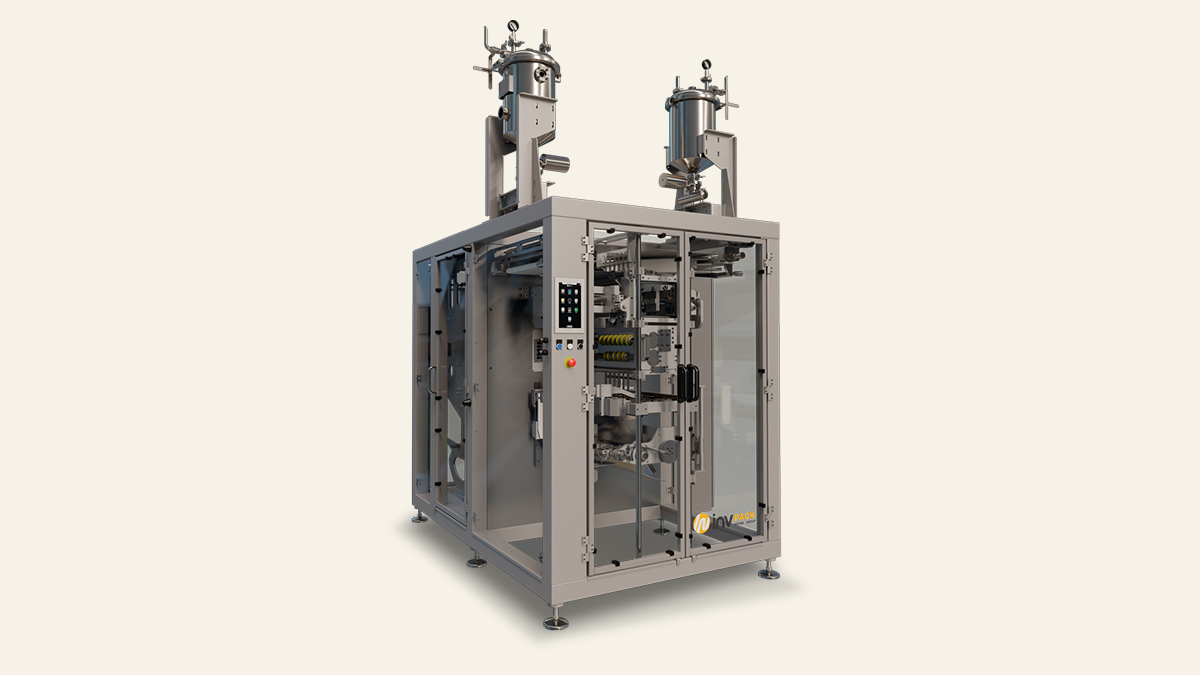
Model no: MVA9
Model no: MVA12
Model no: MVA9
Get in touch here with our team to request a free quote. Our expert team will help you configure the best solution for your production line.
Get in touch with our team for tailored advice on which packaging solution is right for your products.