Technology2 June 2026
How packaging machinery impacts production line throughput
Packaging's influence on total line throughput extends well beyond that. The speed, reliability and integration of packaging machinery shape how efficiently the entire line performs, not just the last few metres of it.
Packaging as the constraint on total output
In many production environments, the packaging stage is the point at which the line is most likely to become the constraint on output. Upstream processing equipment may be capable of supplying product faster than the packaging system can handle it, or the packaging machinery may run inconsistently in a way that creates irregular flow through the line.
The most useful measure of line performance is not the peak speed of any individual machine, but the sustained output in saleable packs per hour across a full shift. Packaging machinery that runs at high speed but stops frequently for film changes, seal faults or product jams may deliver a lower effective throughput than a slower but more stable system.
How packaging speed affects line balance
In a balanced line, each stage runs at a speed that allows the others to operate without interruption.
When packaging is significantly slower than upstream equipment, capacity is lost. Balance is not a matter of matching peak speeds on a spec sheet. It requires understanding the realistic cycle time of the packaging equipment under actual conditions: the product, pack format, seal parameters and the frequency of planned and unplanned stops.
When reviewing packaging machinery options, assess throughput against real operating conditions, not theoretical maximums. The right machine sustains the required output reliably across the full production window, not just briefly under ideal conditions.
Changeover time and its effect on effective output
In production environments where multiple products or pack formats are run on the same line, changeover time is a significant factor in overall throughput. Time spent changing film, adjusting tooling, resetting dosing parameters or cleaning the line between runs is time when the packaging machinery is not producing output.
The impact of changeover frequency depends on run length. For manufacturers running long, stable runs of a single product, changeover time is a minor consideration. For those running shorter or more varied production schedules, it can account for a substantial proportion of available shift time.
Packaging machinery designed for faster changeover, through tool-free adjustments or quick-release components, reduces the time lost between runs and improves effective throughput across the day.
How integration affects throughput across the line
Packaging machinery does not operate in isolation, its performance depends on how well it coordinates with the equipment around it. Integration delivers three things:
- Dynamic line response – when a downstream system stops, the packaging machine can slow or pause in a controlled way rather than creating a backlog.
- Optimum operating speed – each stage runs at its best pace without relying on operators to maintain coordination.
- Real-time data capture – output rates, stop events, seal quality and weight checks feed OEE and continuous improvement programmes with the visibility needed to act.
Inspection and end-of-line equipment
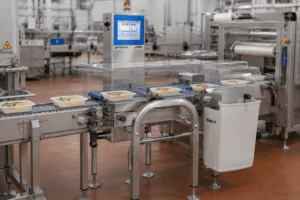
Throughput is also affected by what happens after the packaging stage. In-line checkweighers and metal detectors are standard components in most food packaging lines, and their configuration has a direct effect on how many packs reach despatch.
Inspection equipment that is incorrectly set up or poorly calibrated can generate false rejects, diverting conforming product and reducing effective output. Conversely, equipment that is set too loosely may allow non-conforming packs through, creating quality or compliance risk. The goal is accurate detection that operates at line speed without creating unnecessary interruptions or rework loops.
End-of-line equipment, including case packers, labellers and palletisers, also contributes to total throughput. If any of these stages cannot keep pace with the output from the packaging machine, the line will be constrained at the end rather than the beginning, and the effect on output is the same regardless of where the bottleneck sits.
Reviewing packaging machinery with throughput in mind
When specifying packaging machinery, assess throughput across three dimensions: realistic sustained speed, expected uptime in the operating environment, and how well the machine integrates with surrounding equipment. A machine that performs on all three will contribute more to line output than one that excels on paper but falls short in practice – and the packaging stage is often where the largest throughput gains are found.
Speak to our experts
If packaging is limiting your throughput or you are planning a line upgrade, speak to the ILPRA UK team. We can help you identify the right machinery configuration and integration approach for your product, output targets and operational environment.