Technology8 June 2026
Rotary vs Inline: How Different Fill Seal Pot Fillers Work
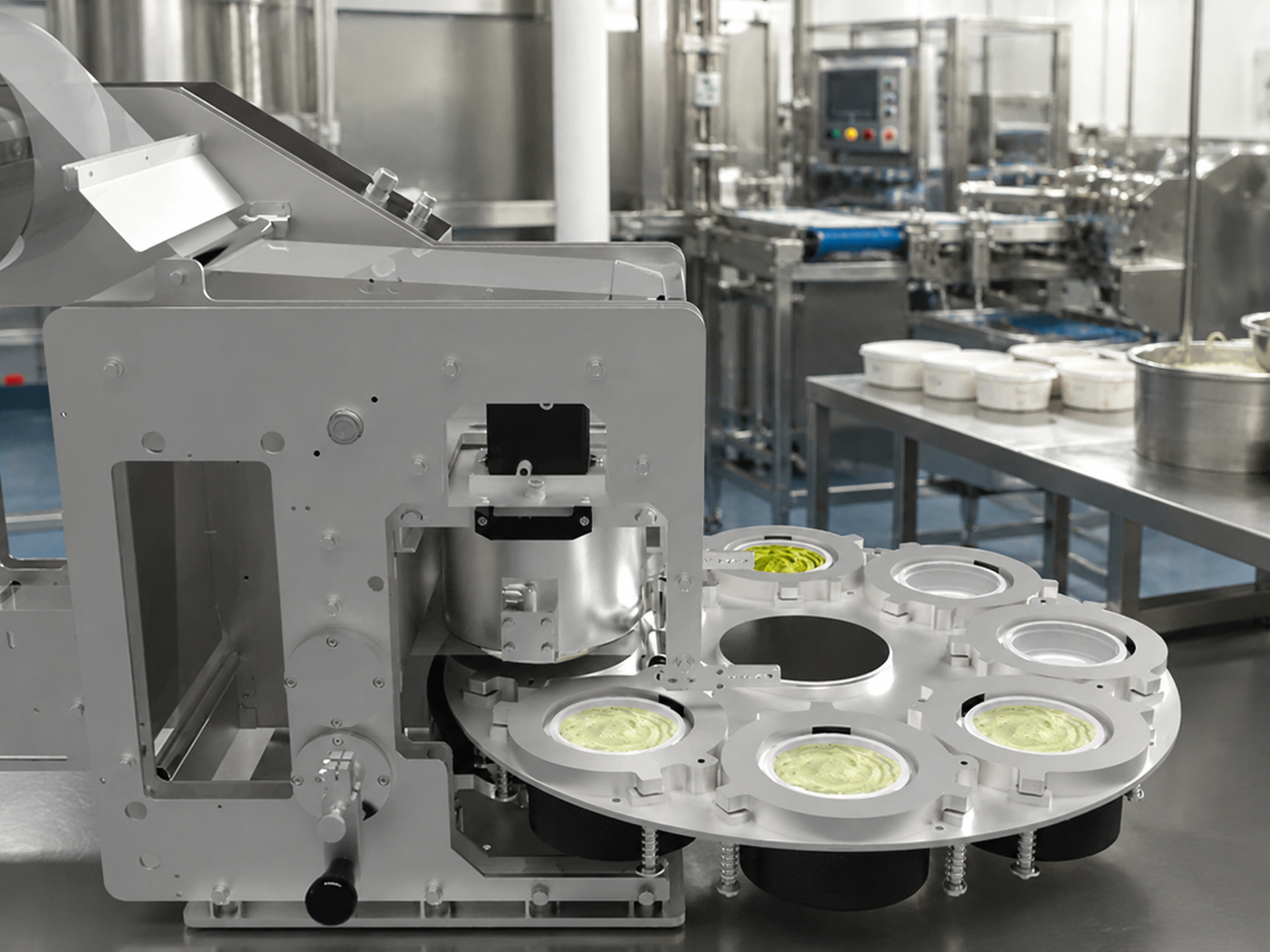
Fill seal machines are available in two main configurations: rotary and inline. Both handle the same core process of filling pre-formed containers and sealing them, but they do so in different ways, and the differences have a direct impact on throughput, format flexibility and how the machine fits into a production line.
How inline fill seal machines work
Inline fill seal machines move containers through the machine in a straight-line path. Containers are fed in at one end, advance through filling and sealing stations in sequence, and exit at the other end as finished packs.
The linear movement makes this configuration well suited to a wide range of container formats and sizes. Tooling and container handling guides can be adjusted to accommodate different pot diameters and depths, and the linear layout makes it relatively straightforward to integrate with upstream and downstream conveyor systems.
Inline systems are commonly used in dairy, condiment, cosmetics and prepared food applications. They handle liquids, semi-liquids, viscous products and particulates depending on the filling system fitted, and they can be configured with a range of sealing options including film sealing, foil and over capping where the machine specification supports it.
This configuration tends to be a practical choice where format flexibility, moderate to high throughput and integration with a broader line are the priorities.
How rotary fill seal machines work
Rotary fill seal machines move containers around a circular carousel. Each position on the carousel represents a stage in the process: loading, filling, sealing and discharge all take place at defined points around the rotation.
Because multiple containers are being processed simultaneously at different stages around the carousel, rotary systems can achieve higher throughput rates than a linear system of equivalent footprint when running compatible container formats at speed. The continuous rotary motion can also support smoother, more consistent handling for certain product and container combinations.
Rotary configurations are often found in higher-output applications where the product range is more consistent, and format changes are less frequent. They are well suited to dairy production, single-serve formats and other applications where sustained high-speed output of a consistent pack is the primary requirement.
The trade-off is that rotary systems can require more involved tooling changes when switching between container formats, which is a relevant consideration for operations running a varied product mix with frequent changeovers.
Dosing and filling in both configurations
The filling stage operates independently of whether the machine is rotary or inline. Both configurations can be fitted with a range of dosing systems depending on the product type and fill accuracy requirements.
For liquid products, volumetric filling is commonly used, dispensing a defined volume per cycle. For products where weight accuracy is critical, weight-controlled dosing provides a tighter tolerance by checking fill weight during the process. For thicker, more viscous products, piston-based systems or auger dosing may be more appropriate. Multi-head dosing is used where multiple fills per container are required, such as yoghurt with a fruit compote layer.
The choice of dosing system should be made based on product behaviour, target fill accuracy and line speed requirements, not on the mechanical configuration of the machine alone. For more detail on selecting the right dosing approach, see our guide on choosing the right dosing system for fill seal applications.
Sealing in inline and rotary systems
Both configurations seal the container after filling using a lidding film applied and sealed across the top of the container. The sealing method, whether heat sealing, induction sealing or ultrasonic sealing, depends on the container material and lid specification.
Sealing parameters, including temperature, pressure and dwell time, are set within the machine control system and recalled as part of the recipe for each product or container type. Consistent sealing is critical for product protection, shelf life where applicable, and pack presentation, particularly for retail-facing products where seal quality is visible to the consumer.
Choosing between rotary and inline
The decision between rotary and inline usually comes down to three things: required throughput, format flexibility and how frequently the line needs to change between products or container sizes. Our team can advise on the right fill seal configuration for your product, container format and output targets.