Technology10 August 2026
Improving product consistency through automated packaging systems
Small variations in filling, sealing or labelling can quickly become rejected packs, rework and inconsistent shelf presentation.
For manufacturers running at industrial scale, holding that variation within tight limits is not a nice-to-have. It is what separates a stable, sellable output from one that generates rework, waste and complaints.
Automated packaging systems address this by controlling the variables that manual and semi-automated processes struggle to hold steady at speed, specifically at the filling, sealing, labelling and inspection stages of the pack process.
Why consistency gets harder to hold as volume increases
Every cycle a machine or operator completes is another opportunity for a small deviation to appear. At low volumes, that deviation is easy to catch and correct. At industrial output, the same deviation is repeated thousands of times before anyone notices, and it is rarely limited to one shift, one operator or one changeover.
Manual and semi-automated processes are particularly exposed to this because they rely on individual attentiveness and technique, which varies from person to person and across the length of a shift, even where standard operating procedures are followed closely. Product batch differences, film variation and pace changes add further sources of drift that a person is reacting to in real time rather than controlling in advance.
Precision filling and dosing accuracy
Automated filling systems are built to hold a target fill weight or volume within a defined tolerance, cycle after cycle, regardless of who is running the shift. The method used depends on the product:
- Volumetric dosing: fills by volume rather than weight, which suits free-flowing liquids and products where density stays relatively stable.
- Weight-controlled dosing: checks and adjusts continually against a target weight, holding fill accuracy within tolerance even where product density or batch characteristics vary.
- Multihead or servo-driven dosing: distributes product across multiple heads to reach an accurate combined weight, which is useful for irregular or free-flowing products such as snacks, granules or produce.
Once these parameters are set for a product and format, the system repeats the same dosing behaviour without the fatigue, distraction or technique variation that affects manual filling. For products filled into pots, cups or pouches, this is covered by our fill seal and pot filling machines, while dry goods and granular products are more commonly handled by vertical form fill and seal systems.
Sealing consistency and pack integrity
Seal quality depends on precise control of temperature, dwell time and pressure at the sealing head. Automated tray sealers and doypack and pouch machines reproduce these parameters precisely on every cycle, rather than relying on an operator judging by feel whether a seal looks right.
Consistent seal strength and seal width support pack integrity, reduce the risk of leakers reaching later stages of the line, and help protect shelf life where the product and film specification are suited to it. Where the line runs multiple pack formats, recipe storage lets the system recall the correct seal settings for each one, so consistency does not depend on an operator resetting parameters manually between changeovers.
Labelling accuracy at speed
Automated labelling applies labels, date codes and batch codes at a fixed position, orientation and pressure, regardless of line speed. Manual or semi-automated labelling is more prone to skewed application, missed labels or inconsistent code placement as speed increases or shifts change over. Our automatic top labelling and top and bottom labelling systems are built around this repeatability.
Because labels carry batch, use-by and traceability information, consistent placement and legibility matter as much for retailer acceptance as they do for pack presentation. A misapplied code is not just a cosmetic issue. It can affect whether a pack is accepted at all.
Inline defect detection as an active consistency control
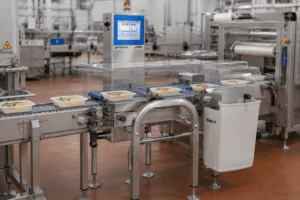
Vision inspection systems, checkweighers and metal detectors are often thought of as a final safety net, but they also function as a consistency control in their own right. Each pack is checked against the same threshold, at the same point in the line, rather than relying on the variable attentiveness of a visual check. Our metal detector and checkweigher combi systems are designed for this role.
Feeding this pack data back to line control also makes it possible to spot drift before it produces a run of failed packs rather than a single reject, such as a seal head running slightly hot or a doser trending away from target weight. We cover the regulatory side of inline inspection, including validation and BRCGS requirements, in more detail in our guide to regulatory compliance and quality assurance in inline inspection.
What consistent packaging delivers at line level
Fewer rejected packs and less rework mean more of what runs through the line is saleable, which supports throughput without necessarily running the line faster. We explore this relationship in more detail in our guide to how packaging machinery impacts production line throughput.
Consistent fill, seal and label quality also reduces the burden on quality control, since fewer packs fall outside specification and need manual review or investigation. For compliance, repeatable pack data supports the validation and record-keeping that regulators and retailers expect, though inspection equipment should sit within a documented food safety system rather than stand alone.
The cumulative effect of reduced waste and rework also feeds into the wider financial case for automation, which we explore in our guide to the ROI of packaging automation.
Consistency depends on the right setup, not automation alone
Automation only delivers consistency when the machine is correctly specified for the product, pack format and line speed, and properly integrated with upstream and downstream equipment. A doser calibrated for one product can behave differently with a different viscosity, particle size or fill temperature. A sealing head pushed above its rated speed for a given format may hold pack rate but lose seal repeatability in the process.
This is why consistency should be reviewed alongside wider line design, not treated as a feature of a single machine. Our guide to key considerations when upgrading packaging equipment covers this in more detail, and our team can help assess where a current setup may be working against consistent output.
Speak to us about improving consistency on your line
If inconsistent fill weights, seals or labelling are creating rework, complaints or compliance risk, it helps to look at every stage together rather than in isolation. Speak to our team today.